The Alim and Alimah course is the traditional path to becoming a scholar of Islam. For centuries it meant years in a madrasa. Today many institutions teach it online, which means a working parent in Toronto or a student in Manchester can study it from home.
This guide explains what the course is, what it covers, how long it takes, and how to choose a program. It also covers the step most guides skip: the Quran foundation every Alim and Alimah student is expected to have before the first lesson.
A note from Hidaya Online: we do not run a full Alim or Alimah program. We teach the Quran foundation that comes before it: Noorani Qaida, fluent Quran reading, Tajweed, word-by-word Translation and Tafseer, one to one with qualified tutors. If you are planning to enrol in an Alim or Alimah course, this is the part we can help you get right. Book a free assessment class.
What is an Alim or Alimah?
The word comes from ʿilm, the Arabic for knowledge. An Alim is a man trained in the Islamic sciences, and an Alimah is a woman with the same training. Both study the same core subjects. Many programs teach sisters separately, often with female teachers.
An Alim or Alimah is not simply someone who knows a lot. They have studied the sources of Islam in a structured way, usually under teachers who themselves learned through an unbroken chain, and they can explain not only what Islam teaches but why.
What does the course cover?
Programs differ by institution and school of thought, but most include:
Quran القرآن
Correct recitation with Tajweed, then Tafseer: the explanation of the verses.
Arabic العربية
Grammar (nahw) and morphology (sarf), to read classical texts directly.
Hadith الحديث
The sayings and actions of the Prophet ﷺ, and how they are authenticated.
Fiqh الفقه
Islamic jurisprudence, from worship to family and financial matters.
Aqeedah العقيدة
The core beliefs of Islam, studied with care and evidence.
Seerah السيرة
The life of the Prophet ﷺ and the history of Islam.
The main objectives of an Alim or Alimah course
- Deep knowledge of the sources. Graduates understand the Quran, Hadith and Fiqh well enough to explain them accurately.
- Applying Islam to daily life. The course teaches how principles apply to modern questions, not only how they were applied in the past.
- Spiritual growth. Study is treated as worship. Students are expected to grow in character, not only in knowledge.
- Leadership and teaching. Many graduates go on to teach, lead prayers, give guidance or serve their communities.
- Preserving the tradition. Knowledge passed from teacher to student keeps classical understanding intact.
- Equal access for women. Alimah programs train women to become scholars and teachers for other women, families and the wider community.
How long does it take?
It varies a great deal. Traditional full-time programs commonly take several years, often quoted at around four to seven. Part-time and online programs usually take longer, because students study fewer hours a week. Always check the specific institution's syllabus and timetable before you enrol.
Online or in person?
| Online | In person | |
|---|---|---|
| Best for | Working adults, parents, families far from a madrasa | Students who can study full time |
| Schedule | Flexible, often evenings and weekends | Fixed daily timetable |
| Teachers | Choose from teachers anywhere, including female teachers | Teachers at one institution |
| Community | Online classmates and forums | Live alongside teachers and students |
| Costs | No travel or accommodation | Travel, accommodation and living costs |
How to choose an online Alim or Alimah program
Before you enrol, ask:
- Who are the teachers, and where did they study? Look for named teachers with recognised qualifications or ijazah.
- Is there a full written syllabus? It should list the texts taught in each year.
- Are classes live, recorded, or both? Live classes let you ask questions; recordings help you catch up.
- How are students assessed? Regular tests and a final assessment are signs of a serious program.
- What Quran level do they expect at entry? Most programs assume you can already read the Quran fluently with Tajweed.
- Are there female teachers for sisters?
- What does it cost in total, including books and exam fees?
The step before the course: your Quran foundation
Almost every Alim and Alimah program expects students to arrive able to read the Quran fluently and correctly. Students who skip this step often struggle in the first year, because Tafseer, Arabic and Hadith all assume confident reading.
A strong foundation usually means:
- Read the letters correctly. Noorani Qaida teaches every letter, vowel and joining rule. Hidaya
- Read the Quran fluently. Quran Reading moves you from words to full passages. Hidaya
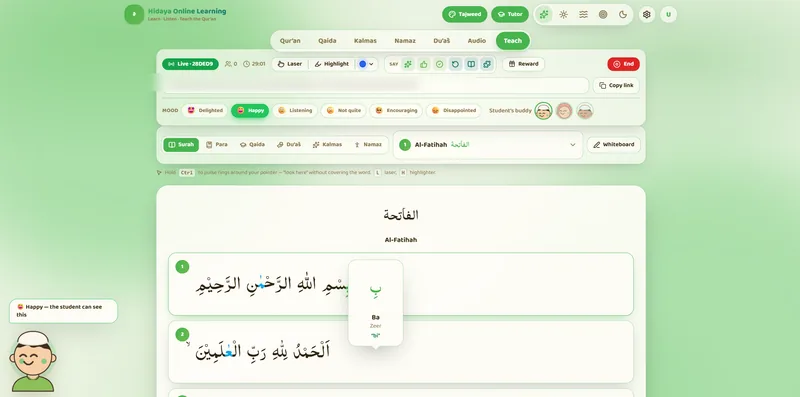
- Recite with Tajweed. Tajweed covers Makharij, Sifaat and the rules of Noon, Meem and Madd, corrected live. Hidaya
- Understand the words. Quran Translation builds word-by-word vocabulary, which makes Arabic grammar far easier later. Hidaya
- Know the context. Quran Tafseer introduces the explanation of verses and the reasons they were revealed. Hidaya
- Begin your Alim or Alimah program at the institution you choose, ready from the first lesson. Next step
Hidaya Online teaches all five, one to one, with male and female tutors and class times in every time zone. Your first class is a free 30-minute assessment, where a tutor tells you honestly how ready your recitation is.
Frequently asked questions
What is the difference between an Alim and an Alimah?
An Alim is a male scholar and an Alimah is a female scholar. Both study the same Islamic sciences.
Can I do an Alim or Alimah course online?
Yes. Many institutions now teach the full program online, usually with live classes and recordings.
How long does an online Alimah course take?
It depends on the institution and how many hours you study each week. Full-time programs commonly take several years; part-time online study usually takes longer.
Do I need to read the Quran fluently before starting?
Most programs expect it. If you are not yet confident, a Quran reading and Tajweed course first will make the Alim or Alimah course much easier.
Does Hidaya Online offer an Alim or Alimah course?
No. We teach the Quran foundation that comes before it: Qaida, Quran reading, Tajweed, Translation, Tafseer and Hifz.